

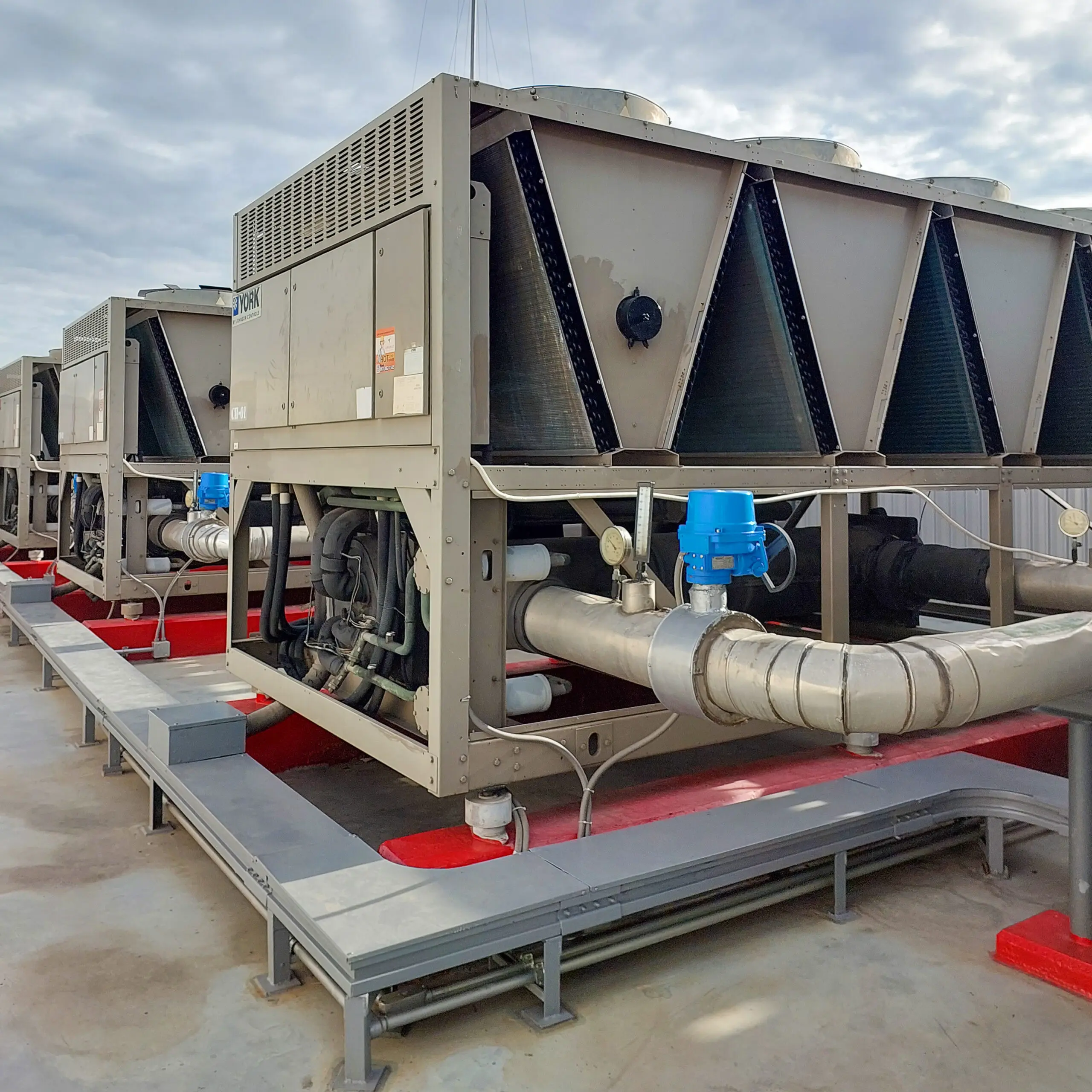


Data center water cooling gets discussed as an efficiency choice, yet it also creates an after-use problem that facilities have to plan for early. Once data center water moves through cooling towers, heat exchangers, and related loops, the question stops being how to remove heat and starts becoming how wastewater will be sampled, routed, treated, reused, or hauled away without disrupting operations.
Water demand gets most of the attention. The harder question sits downstream, because water that has done its job may carry higher dissolved solids, treatment chemicals, and residue that change what wastewater treatment needs to do next.
Heat Rejection Is Only The First Half Of The Story
Direct water use in data centers is tied largely to cooling, which is why water strategy and thermal strategy have to be read together instead of as separate facility topics. A water-cooled design may lower part of the mechanical burden, but it can also increase data center water usage where heat is actually rejected to the atmosphere.
Cooling tower operation explains why. As water recirculates, part of it evaporates to shed heat, while the rest stays in circulation long enough to concentrate dissolved minerals and treatment residuals.
Operators may think of that loop as a utility system, yet once concentration rises, a portion of that water has to leave as blowdown so scaling and corrosion do not start dictating the maintenance calendar. That tradeoff matters for data center energy consumption as well, because a water-heavy cooling choice can improve efficiency in the right climate while still creating a larger wastewater burden after the heat is gone.
Some liquid-cooling and dry-cooler approaches can cut evaporative water use sharply, but they do not remove the need to decide how side streams and off-spec water will be managed.
Blowdown Is Where Cooling Turns Into Wastewater
The water that leaves a cooling tower does not all leave in the same way. Some is lost through evaporation, some through drift or leaks, and some through blowdown, which is the controlled discharge used to manage dissolved solids in the recirculating loop.
Blowdown is where a clean cooling narrative turns into a wastewater management problem. Once that stream leaves the loop, a facility has to decide whether it can be reused internally, sent into an on-site wastewater treatment process, discharged under permit, or routed to a publicly owned treatment works under pretreatment rules and local limits.
Water Quality Usually Decides What Happens Next
Volume attracts attention because it is easy to picture, but water quality usually decides what happens after the water is used. Cooling water can pick up concentrated total dissolved solids, corrosion inhibitors, biocides, suspended matter, and whatever else builds inside the loop as evaporation keeps removing pure water and leaving the dissolved load behind.
Once that happens, wastewater treatment stops being a generic service line and becomes a compatibility question. pH, conductivity, chloride levels, silica loading, metals, and residual treatment chemicals can change whether the water is fit for reuse, acceptable for sewer discharge, or better handled through a dedicated industrial wastewater treatment pathway.
A real-world example makes the point. In Quincy, Washington, data center blowdown with high dissolved solids created problems for the city’s municipal wastewater system, which was not designed for that load, and the response was to process the cooling water blowdown separately through an industrial wastewater treatment plant and then reuse that treated water in a closed-loop program.
Data center water usage stays manageable only when the wastewater treatment path is defined with the same seriousness as the cooling path, and when wastewater treatment compliance is discussed before the first upset forces the issue.
Industrial Cleaning Support Often Determines What The Plan Can Handle
Water chemistry is not the only part of the story. The system also has to deal with scale, settled solids, sludge, and periodic cleanouts in the equipment that stores, moves, or conditions the water after use.
That is where industrial cleaning enters the picture in a practical way. Sumps, trenches, equalization points, cooling basins, and storage tanks do not stay maintenance-free just because the main design intent was thermal control, and once residue accumulates, the wastewater side becomes harder to stabilize.
When the residual side starts building up, vacuum trucks can remove liquids, sludge, and settled material without forcing the facility to improvise around every cleanout. That matters because the blowdown stream is only part of the waste picture; the solids and semi-solids left behind still have to move through an industrial waste transport solution that matches the material and the receiving option.
Industrial cleaning support also protects data center energy consumption indirectly. Fouled exchangers, neglected basins, and dirty collection points can make thermal systems work harder, compress maintenance windows, and turn a manageable wastewater task into an outage-driven response.
Downstream Handling Works Better When It Is Planned Up Front
The strongest plans treat cooling, reuse, and disposal as one operating system. That means looking at data center water usage, wastewater treatment, and data center energy consumption together instead of letting each team optimize a narrow metric.
Early planning changes the questions in a helpful way. Instead of asking only how much water a data hall might consume, operators can ask where blowdown will go, what pretreatment standards apply, how water quality will be tracked, how cleanouts will be performed, and what happens when residuals leave the site.
A centralized wastewater treatment partner, a hauling partner, and the on-site operations team can work from the same assumptions about chemistry, timing, containment, and acceptance, which reduces the chance that wastewater becomes the surprise bottleneck in an otherwise well-designed cooling program.
A Wastewater Plan Belongs In The Design Too
The water story in a data center does not end when heat leaves the rack. A downstream plan has to fit the chemistry, the discharge path, and the cleanup reality.
Environmental Remedies can help connect wastewater treatment, industrial cleaning, and off-site handling before wastewater turns into a reactive problem.Reach out to discuss data center water cooling, wastewater treatment, and the residual streams that follow.