




Data center construction is accelerating across Georgia, and the wastewater side of that growth deserves a lot more attention than it usually gets. Power demand tends to dominate the conversation, but wastewater, wastewater treatment, stormwater controls, and sewer coordination are often where project friction shows up first.
That matters because Georgia is no longer dealing with a few isolated projects. Metro Atlanta has become one of the country’s largest data center markets, and the buildout is moving fast enough that local utilities, site developers, and industrial operators have to think about water systems earlier than they did a few years ago.
Georgia’s Data Center Boom Is Also A Water Infrastructure Story
Recent Georgia water-planning material makes the point clearly: data centers are a water issue as much as an energy issue. The Metropolitan North Georgia Water Planning District says metro Atlanta had more than 50 operating facilities and over 40 additional proposals under consideration as of summer 2025.
That scale changes what data center construction means on the ground. It is no longer one parcel, one utility review, and one set of assumptions about sewer demand or runoff. It is repeated large-footprint development that can arrive in clusters, pushing communities to evaluate water supply, wastewater treatment, and stormwater management at the same time.
The market numbers tell the same story. CBRE reported that Atlanta ended 2025 with 1,459.2 megawatts of inventory, making it the second-largest data center market in the country.
Construction Creates Wastewater Problems Before Servers Ever Turn On
One of the easiest mistakes is treating wastewater as an operations problem that starts after the building is energized. In reality, data center construction can start driving wastewater challenges long before a facility begins handling digital traffic.
Large sites mean mass grading, utility installation, concrete work, dewatering, and the creation of substantial new impervious area. Under EPA rules, construction activity that disturbs one acre or more generally needs stormwater permit coverage because sediment and other pollutants can move off-site during clearing, grading, and excavation.
For Georgia projects, that matters because a fast-moving schedule can turn runoff control into a weak point. Sediment-laden water, concrete washout, fuel handling areas, and temporary sanitary waste streams all have to be managed without assuming the local system can absorb surprises.
A data center site also tends to involve substantial underground utility work. That includes drainage structures, sewer tie-ins, lift station components, or temporary pumping arrangements that can complicate wastewater routing during active construction.
In other words, the wastewater issue is not just what leaves the future cooling system. It is what happens during the months of site disturbance that comes first.
Wastewater Treatment Gets More Complicated When Cooling Choices Change The Water Balance
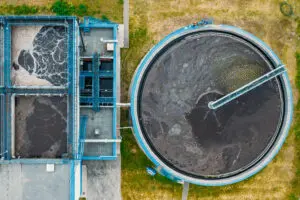
Once the facility is operating, the wastewater picture changes again. A major part of the discussion comes down to cooling design, because the cooling method shapes both water use and what eventually returns to a sewer system or treatment process.
Georgia planners have emphasized that point in recent presentations on data center development from a water perspective. Their materials note that evaporative systems can lose a large share of water to the atmosphere, while closed-loop systems use far less water but still need periodic flushing, refill, and supporting infrastructure.
The same presentation also notes that closed-loop approaches are becoming more common in Georgia proposals, even though they still require real planning around service reliability and wastewater treatment.
That distinction matters because the public often hears that data centers “use water,” but the real operational challenge is more specific. Some water is consumed through evaporation, some becomes blowdown or other residual flow that must be managed, and some may be routed through pretreatment or reuse systems depending on site design.
That is where EPA pretreatment standards for discharges to POTWs become relevant to the broader conversation. When industrial users send wastewater into a publicly owned treatment works, those discharges cannot interfere with plant operations, pass through untreated, or create downstream problems for sludge handling and receiving waters.
For data center construction teams, that means wastewater planning cannot stop at “the utility will take it.” Water chemistry, discharge timing, maintenance cycles, and blowdown management all affect how comfortably a local system can receive the waste stream.
The Data Center Environmental Impact Question Is Often A Local Utility Question
A lot of discussion around data center environmental impact stays abstract. People talk about resource intensity, but the more practical question is whether a given local system can reliably handle what the project adds.
Georgia’s regional planning materials repeatedly push early coordination for that reason. Utilities need to know what kind of cooling is proposed, what drought assumptions are being made, how much redundancy the facility expects, and whether projected discharges line up with real collection and wastewater treatment capacity.
That is especially important in a region where water planning is already sensitive. The Metro Water District notes that Metro Atlanta sits near the headwaters of several small river systems, relies heavily on surface water, and remains drought-prone.
In a setting like that, data center environmental impact is not just about total gallons. It is about timing, return flow, infrastructure readiness, and how much operational flexibility a community actually has during stress periods.
The state conversation is moving in that direction as well. A Georgia Water Planning webinar from March 2026 framed data center development as a regional water-resources issue that touches water supply, wastewater, and stormwater together, not as separate tracks.
Reuse and Offsite Treatment Will Matter More in Georgia
One promising part of the story is that Georgia already offers a useful example of what a less wasteful model can look like. EPA’s updated Water Reuse Action Plan 2.0 points to Google’s Douglas County operation as a case where recycled water is used for data center cooling instead of drawing on the same potable supply used by homes and businesses.
That does not erase the wastewater challenge, i changes the challenge. Reuse still depends on treatment quality, storage, reliability, chemistry management, and coordination between the data center and the wastewater treatment side of the system.
Still, it is a useful direction for Georgia because it shifts the conversation away from simple consumption and toward managed water loops. For the right project, that can mean less strain on potable systems and a better long-term answer than assuming every new facility should rely on fresh water and routine sewer disposal.
Industrial support services matter here too. The more complicated the wastewater stream or maintenance cycle becomes, the more value there is in having partners that understand wastewater treatment equipment, centralized treatment options, and sludge disposal methods instead of treating every liquid waste issue as the same job.
Data Center Construction Needs Wastewater Planning Early
Georgia’s data center construction boom is putting more pressure on wastewater treatment, runoff planning, and local utility coordination. Teams that address those issues early are in a better position to avoid delays, design mismatches, and preventable strain on local systems.
That is where experienced industrial support becomes useful, especially when a project involves wastewater treatment questions, liquid waste handling, or site conditions that need closer review before they turn into a larger problem.Reach out to Environmental Remedies if your team needs support with wastewater treatment, industrial cleaning, or waste handling for Georgia data center construction projects.