



Industrial tank cleaning operates at the point where safety requirements, regulatory compliance, and uninterrupted operations all converge.
Facilities that rely on tanks, vessels, pits, and sumps face layered hazards during industrial tank cleaning, ranging from confined atmospheres to high-energy equipment and regulated waste streams. The decisions made regarding the execution of this work influence worker safety, inspection results, and the length of downtime.
Early planning that treats industrial tank cleaning as a specialized discipline, rather than a routine maintenance task, often leads operators toward outsourced solutions supported by proven programs, trained crews, and predictable execution.
Why Industrial Tank Cleaning Is Treated as a High-Risk Activity
Few maintenance tasks combine as many exposure pathways as industrial tank cleaning.
Tanks frequently meet the definition of permit-required confined spaces under Occupational Safety and Health Administration guidance, meaning limited entry, restricted exits, and atmospheres that can shift rapidly.
Oxygen deficiency below 19.5%, flammable vapor accumulation, and toxic residues all remain realistic threats during confined space cleaning, especially when residues have settled over long service intervals.
Rescue planning adds another layer of concern. According to the National Institute for Occupational Safety and Health, attempted rescuers are involved in most fatalities in confined spaces, highlighting how improvised responses raise risk.
When tank cleaning safety depends on making quick decisions under pressure, experience and preparation are essential.
Maintaining a high level of rescue readiness is often challenging for facilities that perform this work infrequently, particularly when multiple tanks or vessels need to be attended to in short amounts of time.
Safety Performance Improves When Cleaning Programs Are Purpose-Built
Outsourced providers approach industrial tank cleaning as a repeatable system rather than a one-off task. Dedicated teams typically arrive with defined entrant, attendant, and supervisor roles, calibrated gas detection, ventilation equipment, and documented permits aligned with OSHA expectations.
Such a structure reduces variability during confined space cleaning, where inconsistent monitoring or unclear authority can create silent exposure events.
Atmospheric testing protocols illustrate the difference. Professional crews follow disciplined sequences for oxygen, flammables, and toxics, paired with continuous monitoring and clear stop-work thresholds.
Facilities relying on in-house resources may perform pre-entry checks yet lack the staffing or equipment to maintain oversight throughout the job. Over time, outsourcing strengthens tank cleaning safety by treating monitoring as an active control rather than a checklist item.
Rescue Readiness Benefits From Repetition and Specialized Equipment
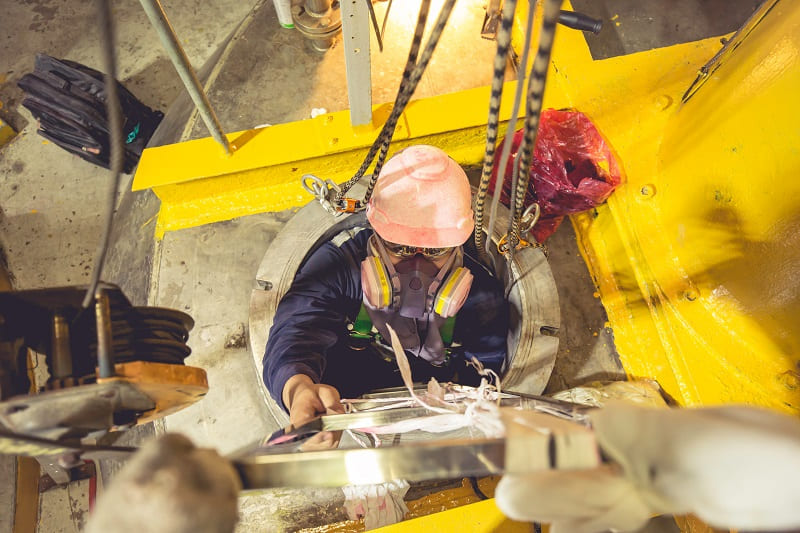
Rescue planning rarely receives daily practice inside most facilities. Outsourced industrial tank cleaning teams receive specialized training in non-entry material retrieval, rehearsed access routes, and close coordination with on-site personnel.
OSHA guidance emphasizes evaluating rescuer capabilities and conducting periodic drills; meeting those expectations internally can strain resources when tank work occurs sporadically.
Specialists bring retrieval systems and rehearsed procedures designed for confined space cleaning scenarios. Such preparation reduces the chance that an initial incident cascades into multiple injuries, a pattern documented repeatedly in confined space fatality investigations.
Technical Capability Shapes Both Risk and Downtime
High-energy methods such as hydroblasting and industrial vacuuming alter the risk profile of industrial tank cleaning.
Water at tens of thousands of psi can punch through skin. OSHA’s case files make that clear. Add noise and fall hazards, and the risk stacks up fast. The WaterJet Technology Association’s baseline is simple: train operators well and keep gear in top condition.
Specialized contract crews bring the right tools and filtration for the job. That means faster setups, shorter entries, and sometimes reduced-entry methods that keep people farther from the hazard. Less time inside a confined space equals less exposure.
Clean thoroughly, and inspections go smoother. Residues don’t hide problems, rework drops, and schedules to return assets to service get clearer. Better planning. Fewer surprises. Steadier maintenance.
Standards-Based Planning Supports Predictable Return to Service
In practice, tank cleaning extends beyond residue removal to include preparation, safety controls, and follow-up steps.
Recognized frameworks such as American Petroleum Institute Standard 2015 describe coordinated steps from isolation through recommissioning. Experienced providers plan industrial tank cleaning jobs around these steps: freeing the gas, controlling ignition, choosing the right method, and doing a final inspection.
Facilities that handle this process in-house may put a lot of effort into cleaning and not enough into recommissioning checks. OSHA guidance points out that return-to-service remains a defined phase with its own hazards.
Outsourcing brings consistency across those stages, supporting predictable restarts and fewer inspection delays tied to incomplete documentation.
Environmental And Waste Controls Extend Beyond the Tank
Residues, sludges, and rinsates generated during industrial tank cleaning often trigger hazardous waste determinations under federal rules administered by the United States Environmental Protection Agency.
Contractors removing hazardous residues can be considered co-generators alongside the facility, meaning responsibility remains shared rather than transferred. That reality elevates the importance of documentation, segregation, and profiling throughout the job.
Experienced vendors include waste management in their industrial maintenance plans. They coordinate the capture, labeling, manifesting, and shipping of waste while maintaining the documentation required by federal and state programs.
Wastewater isn’t a free pass to the drain. Pretreatment rules and local limits decide what you can send and when. Assumptions about “it’s just wash water” turn into citations fast.
Outsourcing helps you get in front of it. Specialists build capture, treatment, and documentation around your permit, not guesswork. Sampling plans match local limits. Disposal routes are verified.
In oil storage settings, they fold those controls into SPCC planning, so spill prevention and discharge compliance move together. Fewer surprises. Cleaner records. Steadier operations.
Business Predictability Ties Safety And Compliance Together
Many operators outsource tank cleaning for steady, predictable results. Clear scope. Trained crews. Safer entries. Fewer surprises, less downtime, and work that lands on schedule.
Dedicated crews mobilize with the right equipment, follow defined critical paths, and deliver documentation that supports audits and insurer reviews. Instead of being spread out, confined space permits, rescue plans, waste records, and recommissioning checklists are all in one place.
Facilities benefit when tank cleaning safety, environmental compliance, and schedule control reinforce one another. Reduced variability lowers the likelihood of extended outages due to rework or regulatory questions, keeping maintenance windows aligned with production goals.
Over time, hiring outside help changes industrial maintenance from just fixing problems as they come up to organizing it in a planned way, using data and consistent
Industrial Tank Cleaning That Supports Safer And Predictable Operations
Facilities weighing how to approach industrial tank cleaning often reach the same conclusion after examining safety data, regulatory expectations, and downtime costs. Outsourcing pulls confined space cleaning, rescue readiness, and waste handling into one coordinated playbook.
If you want dependable results without stretching your team, partner with Environmental Remedies. Our specialists bring safe entries, clean exits, and steady schedules. Reach out to line up your next tank cleaning and plan the shutdown with confidence.